Yes, Penn State provides public access to buildings, monuments and natural heritage landscapes of cultural significance. Policy AD68 University Access Policy states “It is the policy of The Pennsylvania State University to preserve an open access environment” and outlines how special access areas (granted when access to facilities cannot be achieved via established locking and unlocking schedules) can be accessed by faculty, staff, students and representatives of organizations having contractual agreements with the University.
The University preserves an open access environment and all significant buildings are open to the public from 8am to 5pm.
Buildings:
Old Main – the original Old Main building was completed in 1862, seven years after the university was founded, and provided housing for students and faculty alike, and contained the chapel, dining facilities, library, classrooms, laboratories, museum, and student association rooms. Today the building is the symbol of the University for alumni and visitors. On the walls of the main lobby are the Land Grant Frescoes painted by Henry Varnum Poor, one of America’s outstanding muralists.
University House – The home of 11 of the University’s 14 presidents from 1864 to 1970, it was designed by Evan Pugh as a country Georgian mansion–very similar in layout to those of the county’s ironmasters. There have been a number of alterations and renovations over the years, but the house is still a symbol of the hospitality of the University.
The Carnegie Building – The home of the College’s first library outside of Old Main was constructed in 1904. Trustee and steel magnate Andrew Carnegie was internationally known for donating library buildings to hundreds of communities and colleges. His one hundred thousand dollar bequest was made here on the condition that the legislature buy the books to fill it. After the opening of Pattee Library, Carnegie was converted to classroom and office use.
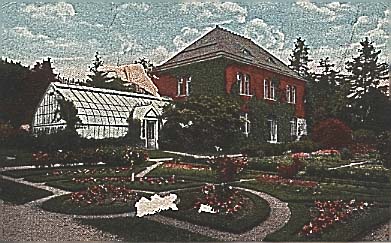
Old Botany (pictured below) – Built in 1887, it is the oldest building on campus whose exterior has not been altered over the years. It was designed by College Architect F. L. Olds in the “Richardsonian Romanesque” style that he also used in the Old Engineering building and the Armory. The most notable features are the large semicircular window on the east facade, eyelid dormers and terra cotta ornamentation on the ridge of the roof. The building first housed botany laboratories and had greenhouses attached and a formal garden in front, laid out by students in 1861. The interior is considerably altered and today is used for administrative offices.

Monuments

Photograph by Eldon McGraw from source.
Nittany Lion Shrine – On April 20, 1904, the Penn State nine (the nine members on the baseball team) were visiting Princeton for a baseball game. When freshman H. D. “Joe” Mason (class of 1907) was shown two Bengal tigers as an indication of the merciless treatment they would encounter, Joe responded with an instant fabrication of the Penn State Nittany Mountain Lion, who could overcome even Princeton’s tiger. The idea persisted over the years and Penn State’s athletic teams adopted the symbol. Confusion with the African Lion was common until the class of 1940 commissioned Heinz Warneke to sculpt the symbol as a class gift. Warneke worked under a tent on the Indiana Limestone at the site and on October 24, 1942 the shrine was dedicated and accepted by the College. It’s now the most recognized symbol of Penn State world-wide. Publicly accessible.
President Atherton’s Grave – George W. Atherton served twenty-four years–the longest tenure of any Penn State president. When Atherton arrived, the College was just emerging from almost twenty years of curricular disarray and two legislative investigations. Atherton’s tenure saw enrollment rise from 87 to 800, the first substantial buildings added, and a curricular direction established which continues today. President Atherton died on July 24, 1906 and was buried on the north side of Schwab Auditorium. In 1982 the University surrounded the marble slab with a small meditation courtyard backed by a granite wall bearing a likeness of Atherton and his surname in bronze letters. Publicly accessible.

Obelisk – The polylith, as it was originally called, is a geologic monument. It consists of samples of Pennsylvania building stone from throughout the state and was constructed in 1896. The effect on the virtuousness of passing coeds on its stability has been a favorite student tradition for many years. Publicly accessible.
Natural Heritage Landscapes: free and open to the public
The Arboretum at Penn State – The H.O. Smith Botanic Gardens and all other parts of the Arboretum are open to the public without charge. The Arboretum is a University facility for study, research, reflection, and enjoyment.
Shaver’s Creek Environmental Center – Shaver’s Creek provides free public access to an aviary, herpetarium, indoor bird-watching station, ponds, pollinator gardens, interpretive environmental learning, trails for hiking, spots for picnicking, and more.

Hort Woods – In 2001, Hort Woods earned “Heritage Grove” status through the University’s Heritage Trees and Groves policy, designed to protect specimen trees or groves on campus that have exceptional historic, cultural and aesthetic value at Penn State. In the 1800s, Hort Woods stretched from central campus to the Penn State Arboretum site. The original Hort Woods was cleared for construction. The remaining patch of land contains some surviving trees, or at least their progeny, in a 4-acre remnant patch of oak-hickory forest. The oldest trees in this grove existed prior to the start of campus construction in 1859. Hort Woods has long been considered an important campus green space. Publicly accessible.
More information about publicly accessible Penn State Landmarks can be found on this library Penn State Landmarks webpage.
Learn more about Penn State’s progress on the UN’s Sustainable Development Goals on the SDG Progress page HERE, and learn more about work on SDG 11 HERE.