
End poverty in all its forms everywhere
Targets for to reach to achieve this goal include eradicating extreme poverty; reducing the proportion of people living in poverty; implementing nationally appropriate social protection systems and measures; ensuring all have equal rights to economic resources, basic services, and ownership and control over technology and financial services; building the resilience of the poor and vulnerable and reduce exposure and vulnerability to climate-related extreme events; ensuring significant mobilization of resources to developing countries to implement programs and policies to end poverty in all its dimensions; and, creating sound policy frameworks at national, regional and international levels. Details about each target for Sustainable Development Goal 1 can be found below.
Learn more about Penn State’s progress on all the Sustainable Development Goals on the SDG Progress page.

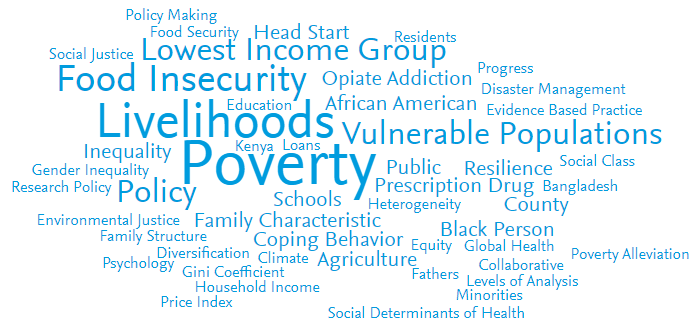
Source: SciVal.com | This word cloud was created using publications from Penn State researchers
Related News
Secure access to food and water decreasing for US children
Between 2005 and 2020, the number of children facing simultaneous water and food insecurity in the United States more than doubled. Additionally, Black and Hispanic children were several times more likely than white children to [...]
Penn State student organizations take action to help combat food insecurity
Penn State students are taking bold steps to tackle food insecurity and ensure that all students have access to nutritious meals. According to the Food and Housing Needs Survey conducted by Penn State Student Affairs in fall [...]
Threads for Med Ed student club prioritizes sustainability in innovative ways
Threads for Med Ed, or T4ME, a medical student club at Penn State’s College of Medicine, is taking a creative, multidimensional approach to addressing issues of sustainability. T4ME collects donations of professional clothing from College [...]
Threads for Med Ed student club prioritizes sustainability in innovative ways
Threads for Med Ed, or T4ME, a medical student club at Penn State’s College of Medicine, is taking a creative, multidimensional approach to addressing issues of sustainability. T4ME collects donations of professional clothing from College [...]
Supporting Evidence
No, Penn State doesn’t have a specific published target. However, Penn State routinely tracks the opportunity gaps that are seen in success statistics between non-advantaged populations and the majority. This includes low-income students as well as first generation students and underrepresented minority students. Penn State believes in equitable outcomes, which would mean the elimination of these gaps.
Yes, Penn State provides multiple food and transportation services for students of low income backgrounds. The Lion’s Pantry is a student-run food bank at Penn State University Park that provides free food and toiletries to students facing food insecurity. Established in 2014, it aims to combat hunger, raise awareness about student poverty, and reduce stigma around food insecurity. There are also Cub Pantries at Penn State satellite campuses, which are the branch equivalents of the Lion’s Pantry. Penn State also has an exclusive ride sharing program called RideOn to help students, faculty, and staff find rides to campus. Finally, Penn State Legal Services is a resource for all students to gain advice, referrals, document drafting, and other legal services.
Yes, Penn State has programs to help students from low-income groups to complete their studies. A University-wide initiative, called “Achieve Penn State,” helps students and families by removing obstacles to graduation, lowering debt, and shortening time to degree, supporting President Eric Barron’s focus on access and affordability. Part of this initiative is “Complete Penn State,” which provides seniors facing financial obstacles with academic and financial resources to help them complete their degree. The Penn State Chaiken Student Center for Success also provides financial, academic, career, and mentorship opportunities for first-generation and liberal arts students to help complete their studies. The Comprehensive Studies Program at Penn State provides access and retention support to Pennsylvania students with high academic potential, meeting economic criteria, and often being first-generation college students. The university also participates in various Federal TRIO Programs, which assist low-income, first-generation, and disabled individuals from middle school through post-baccalaureate education. Additionally, the Penn State Millennium Scholars Program supports academically strong high school seniors aiming for doctoral degrees in science or engineering, promoting diversity in research fields. A University-wide initiative, “Achieve Penn State,” helps students and families by removing obstacles to graduation, lowering debt, and shortening time to degree, supporting former President Eric Barron’s focus on access and affordability.
While Penn State does not provide resources specifically for financially and socially sustainable businesses, any student with a start-up idea can be supported through a Program at Penn State called the Launch Box. This provides mentoring, training, and access to university facilities to Students with a viable business idea, and can encourage start-ups that are both socially and financially responsible. Additionally, any community member can gain access to the resources above if they have a viable business idea.
Yes, Invent Penn State provides mentoring and financial support to community members if they have a viable business idea.
Yes, there are multiple ways that Penn State tries to improve access to basic services. Sanitary products are now free at the Penn State University Park campus. Additionally, there are food pantries across the Penn State Campuses to provide food to food insecure students. Additionally, there are free health resources for students on campus, such as Counseling and Psychological Services and Sexual and Reproductive Services. Additionally, there is the Food and Housing Security Task Force, which aims to mitigate food and housing insecurity for low income students.
Penn State research efforts have been used to help mitigate poverty at the local level. For instance, the Penn State Social Science Research Institute conducts research to make Food Banks more efficient to increase access to food to communities that need it. Additionally, Penn State has a multitude of programs aimed towards ending student poverty on campus, which includes Swipe Out Hunger, the Lion’s Pantry, and the Student Farm. Please read more about these initiatives here.
About this SDG
Targets & Indicators
Target 1.1: By 2030, eradicate extreme poverty for all people everywhere, currently measured as people living on less than $1.25 a day
- Indicator 1.1.1: Proportion of the population living below the international poverty line by sex, age, employment status and geographic location (urban/rural)
Target 1.2: By 2030, reduce at least by half the proportion of men, women and children of all ages living in poverty in all its dimensions according to national definitions
- Indicator 1.2.1: Proportion of population living below the national poverty line, by sex and age
- Indicator 1.2.2: Proportion of men, women and children of all ages living in poverty in all its dimensions according to national definitions
Target 1.3: Implement nationally appropriate social protection systems and measures for all, including floors, and by 2030 achieve substantial coverage of the poor and the vulnerable
- Indicator 1.3.1: Proportion of population covered by social protection floors/systems, by sex, distinguishing children, unemployed persons, older persons, persons with disabilities, pregnant women, newborns, work-injury victims and the poor and the vulnerable
Target 1.4: By 2030, ensure that all men and women, in particular the poor and the vulnerable, have equal rights to economic resources, as well as access to basic services, ownership and control over land and other forms of property, inheritance, natural resources, appropriate new technology and financial services, including microfinance
- Indicator 1.4.1: Proportion of population living in households with access to basic services
- Indicator 1.4.2: Proportion of total adult population with secure tenure rights to land, (a) with legally recognized documentation, and (b) who perceive their rights to land as secure, by sex and type of tenure
Target 1.5: By 2030, build the resilience of the poor and those in vulnerable situations and reduce their exposure and vulnerability to climate-related extreme events and other economic, social and environmental shocks and disasters
- Indicator 1.5.1: Number of deaths, missing persons and directly affected persons attributed to disasters per 100,000 population
- Indicator 1.5.2: Direct economic loss attributed to disasters in relation to global gross domestic product (GDP)
- Indicator 1.5.3: Number of countries that adopt and implement national disaster risk reduction strategies in line with the Sendai Framework for Disaster Risk Reduction 2015–2030
- Indicator 1.5.4: Proportion of local governments that adopt and implement local disaster risk reduction strategies in line with national disaster risk reduction strategies
Target 1.a: Ensure significant mobilization of resources from a variety of sources, including through enhanced development cooperation, in order to provide adequate and predictable means for developing countries, in particular least developed countries, to implement programmes and policies to end poverty in all its dimensions
- Indicator 1.a.1: Total official development assistance grants from all donors that focus on poverty reduction as a share of the recipient country’s gross national income
- Indicator 1.a.2: Proportion of total government spending on essential services (education, health and social protection)
Target 1.b: Create sound policy frameworks at the national, regional and international levels, based on pro-poor and gender-sensitive development strategies, to support accelerated investment in poverty eradication actions
- Indicator 1.b.1: Pro-poor public social spending