


What is Penn State Sustainable Labs?

Each participating lab commits to:
- appointing a My Green Lab Coordinator (MGLC) to lead the lab’s efforts throughout the year
- utilizing the MGL 2.0 platform to take the engagement survey and fill out the assessment tool
- reviewing the resulting report
- making some improvements over the course of six months during an academic year (fall and spring semesters) and continuously update the assessment tool and imapct estimator
- retaking the survey for a final rating by My Green Lab
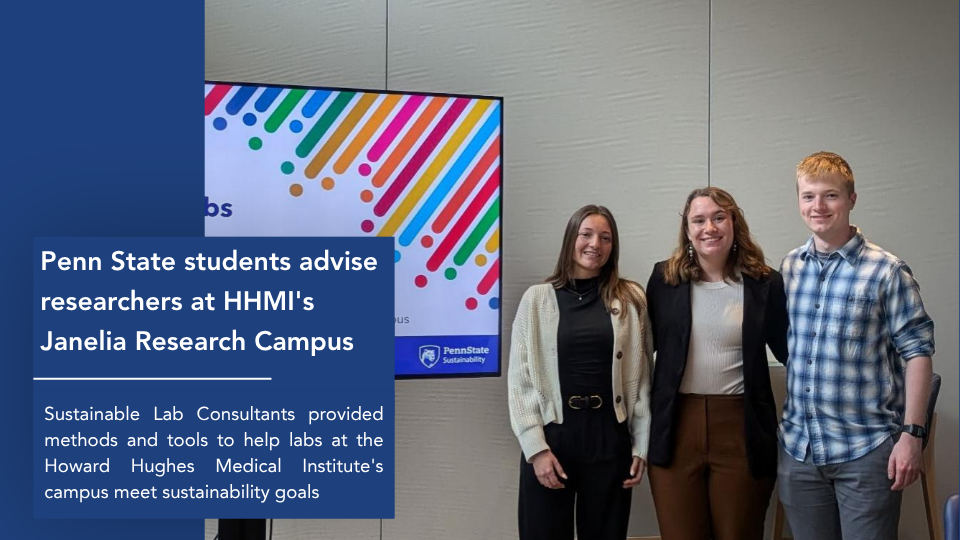
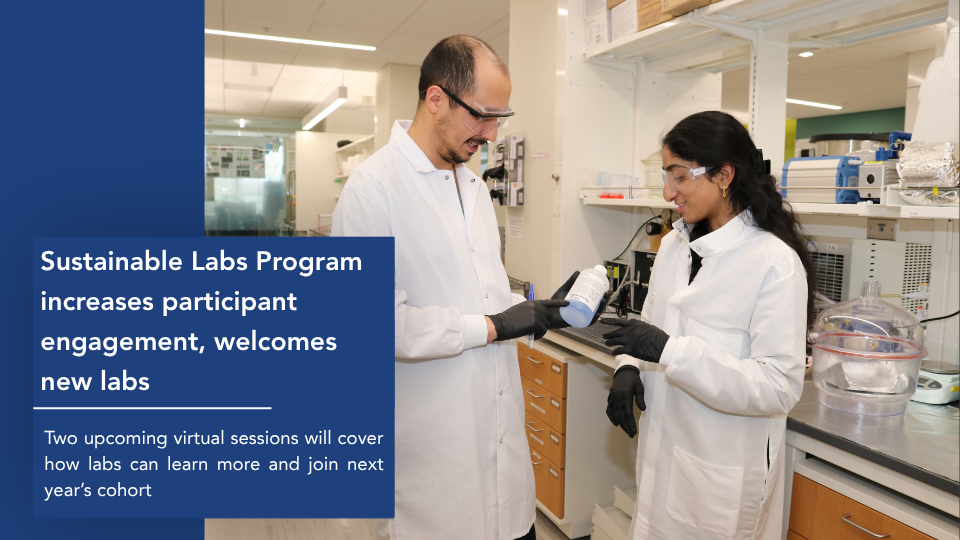
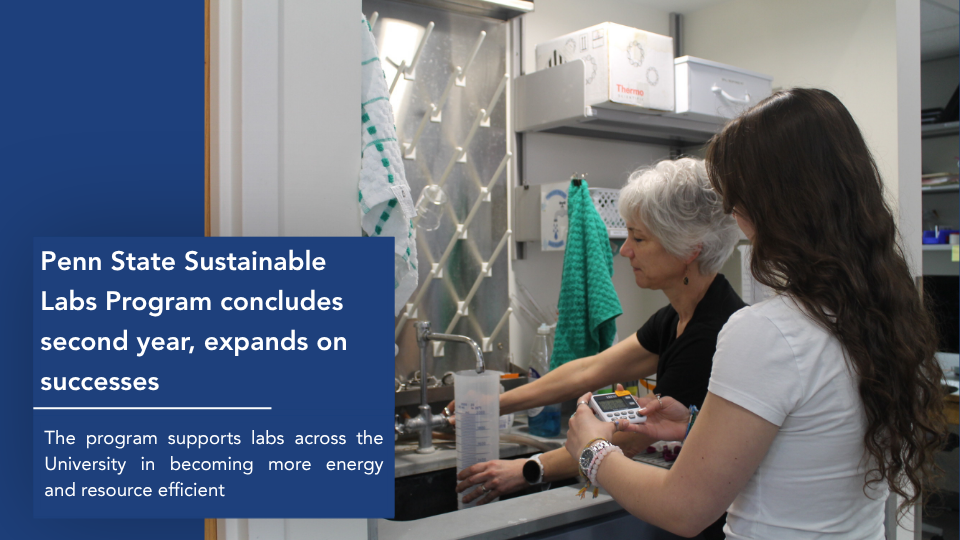
Educational support and networking opportunities are provided to participating researchers by MGL and the Sustainable Labs Leadership Team guiding the project. Labs have the option of being paired with a paid undergraduate student, a Sustainable Lab Consultant (SLC), who is trained by Penn State Sustainability staff to support the researchers’ desired improvements. Each MGL Coordinator (MGLC) mentors the undergraduate student.
Since this program’s inception in September 2022, labs have:
- closed fume hoods
- replaced hazardous chemicals
- learned more about sustainable practices
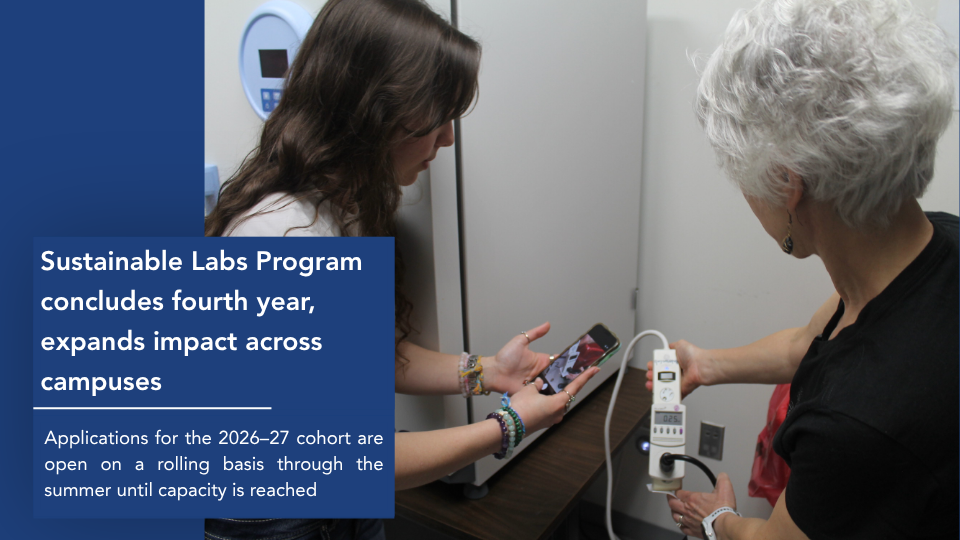
- turned off and/or unplugged unused equipment
- turned up ultra-low freezers as part of the MGL Freezer Challenge
These changes not only save money and reduce the University’s greenhouse gas emissions, but they also improve safety, all while maintaining the integrity of the research. The Leadership Team will be quantifying the impacts of these changes at the end of the program’s first year.

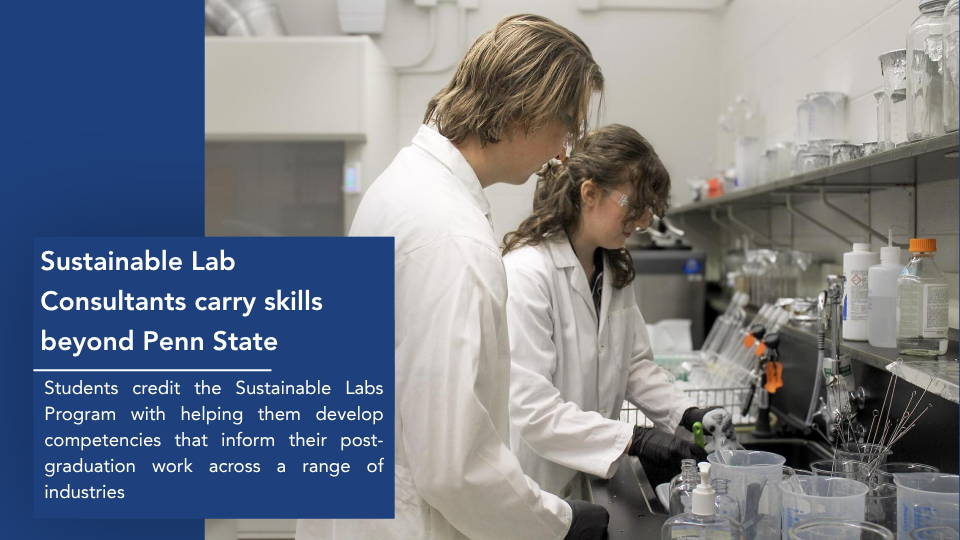
The Penn State Sustainable Lab Consultant (SLC) program is co-curricular experiential learning approach to creating a more sustainable research lab culture and operation, while preparing researchers to build a more sustainable world in their future careers.
Recognizing the educational value of offering undergraduate students hands-on experiential learning, the SLCs receive formal educational training about sustainable research practices and behavior change approaches. Each student is paired with a research laboratory and provided a $1400 stipend in exchange for working approximately 3 hours a week throughout the academic year.
The SLCs familiarize themselves with the lab’s research, instruments, and members as well as Penn State and My Green Lab resources. They engage with a structured training curriculum to learn about sustainability concepts, effective communication strategies, project management approaches, and behavior change motivators. Throughout the year, they put their knowledge and skill sets into action to inform, support, and augment desired improvements in research practices determined by the members of their lab.
 Penn State, a Tier 1 Research University with over $1 billion in annual research expenditures, is proud of its interdisciplinary approaches to solving local and global problems, many of which address sustainability challenges. The research lab environment has its own sustainability challenges.
For example, Penn State research represents 45% of the University’s energy consumption, yet only 21% of the space. This environment also provides a strong training ground for learning about sustainable research practices.
The Sustainable Lab Program was launched to improve daily behaviors and decisions by researchers without compromising research quality and productivity while reducing negative impacts. In 2022-23, the first year, the project was implemented in 25 labs and involved over 200 researchers across five colleges and two Commonwealth campuses. Five of these labs were each paired with a paid undergraduate student. Recognizing the educational value of offering undergraduate students hands-on experiential learning, the University’s Sustainable Labs Leadership Team created a formal educational training curriculum introducing a cohort of five selected Sustainable Lab Ambassador (SLA) (renamed Sustainable Lab Consultants, or SLCs, in 2024) students to sustainable research practices and behavior change approaches. In 2022-23, each student was paired with an Engineering lab because their stipend was funded by a grant from the College of Engineering’s Leonhard Center. The anticipated financial savings, energy and waste reduction, and lower environmental impact were accompanied by education and training of the researchers for conducting tasks in more sustainability-minded ways. For the undergraduate and graduate student researchers, the training makes their skills highly valuable for future career opportunities in academia and industry.
For the second pilot year in the 2023-24 academic year, the program expanded the cohort of SLC students to 15 and 25 new labs. Three students returned to participate in the program, two in leadership roles that supported the students and the lab leadership team.
In the third pilot year of the program, one student returned for a third year with the program and four others returned for a second year (two in labs and two as mentors). Ten students joined for a first year supporting research labs.
The results made evident that SLC support positively impacts a lab’s certification efforts. Over the first three years, 49% of non-SLC labs were certified at the highest levels (Platinum and Green). For SLC labs, 89% were certified at the highest levels indicating greater engagement and actions in the labs to reduce waste, improve efficiency, and build a supportive sustainability culture.
In the fourth year of the program, and the first non-pilot year, two students returned as “Senior SLCs” to support the Leadership team and mentor the 14 incoming students that included one returning for a second year with a lab.
Penn State’s Sustainable Lab Program Recognized Internationally

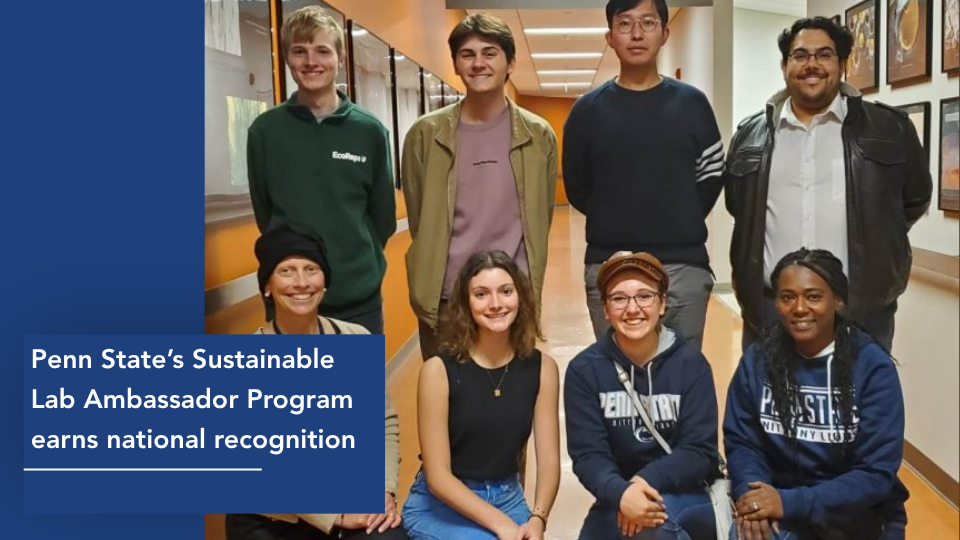
In the fall of 2023, Penn State’s Sustainable Lab Program was recognized for its unique approach to promoting experiential learning and environmental stewardship by The International Institute for Sustainable Laboratories (I2SL) with an Honorable Mention in its Sustainable Laboratory Awards program.
The award was given for the approach of developing and operating the Sustainable Lab Consultant (formerly Sustainable Lab Ambassador) program to support research labs as they shift towards more sustainable practices.
The I2SL Sustainable Laboratory Awards recognize projects, programs, and people that decrease greenhouse gas emissions, improve water and energy efficiency, divert waste from landfills, and promote sustainable best practices.
Certification Process
How we use My Green Lab
Penn State has an established partnership with My Green Lab (MGL) and has adopted their Certification program as a core component of our University’s Sustainable Lab Program. MGL is widely recognized as the gold standard in sustainable lab practices, endorsed by the UN Race to Zero Campaign. While approximately fifty percent of MGL’s clients are pharmaceutical and chemical companies, they are actively expanding their work with universities. Unlike standard sustainability checklists, MGL’s program focuses on fostering behavior changes and sparking meaningful discussions among researchers about opportunities for improvement across fourteen key categories:


Lab Resources
Deciding if the Sustainable Labs program works for your lab? Access these three resources to strengthen your understanding of green labs, practical reduction strategies, resources at Penn State, and your lab’s potential footprint.
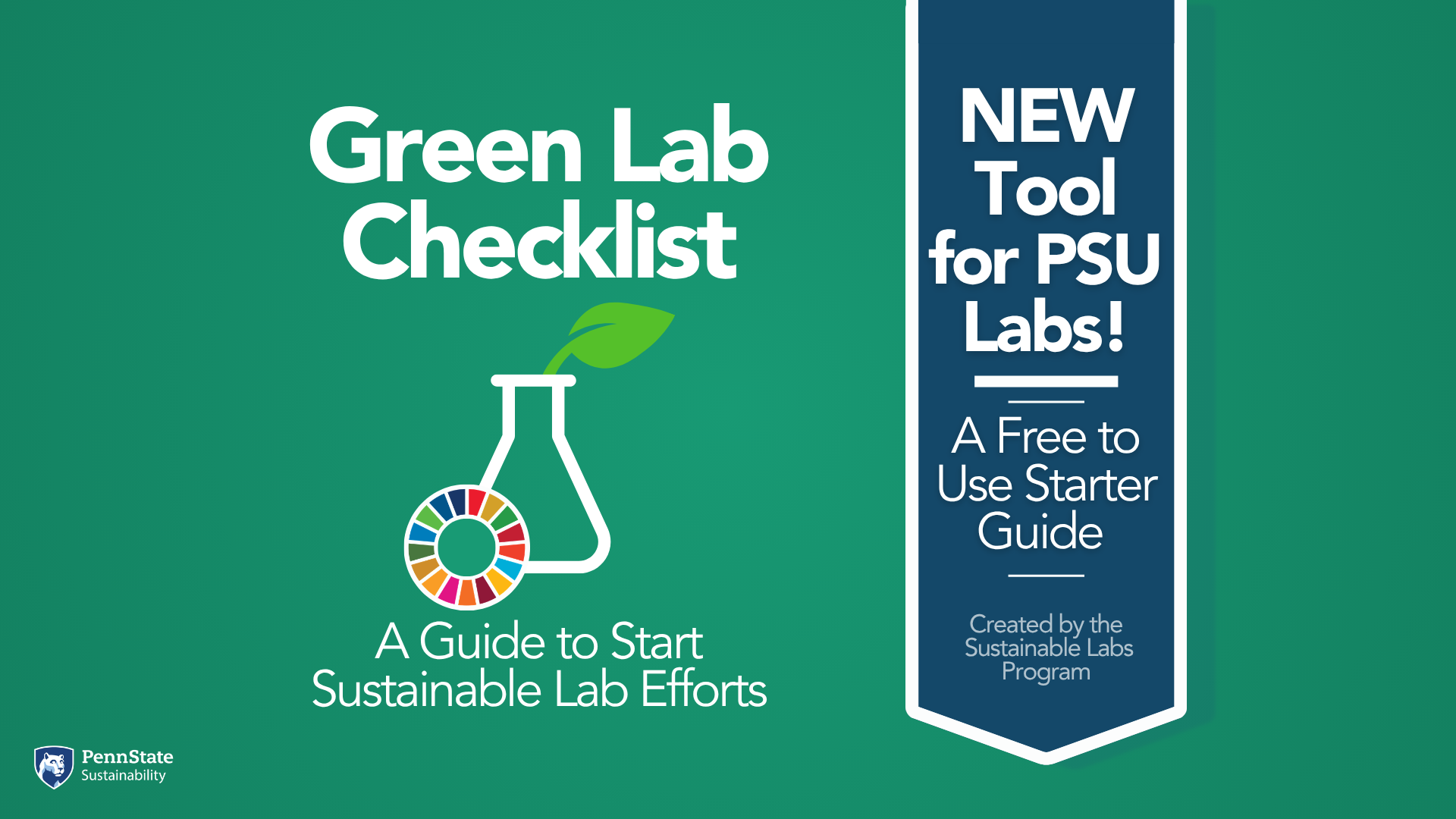
The Green Lab Checklist is perfect for any lab who wants to become more sustainable without officially certifying via My Green Lab.
This checklist is a comprehensive collection of tools, resources, and information from standard green lab procedures to university guidelines.
Upon completion, any Penn State Lab can send their completed pledge page in exchange for signage, auditing tools, and more.
Congratulations to the labs that have attained My Green Lab Certification!