
Ensure access to affordable, reliable, sustainable and modern energy for all
In order to meet this goal the targets are to ensure universal access to affordable, reliable and modern energy services; increase the share of renewable energy; double the global rate of improvement in energy efficiency; enhance international cooperation to facilitate access to clean energy research and technology; and to expand infrastructure and upgrade technology. Learn more about this goal in the Targets & Indicators section below.
Learn more about Penn State’s progress on all the Sustainable Development Goals on the SDG Progress page.
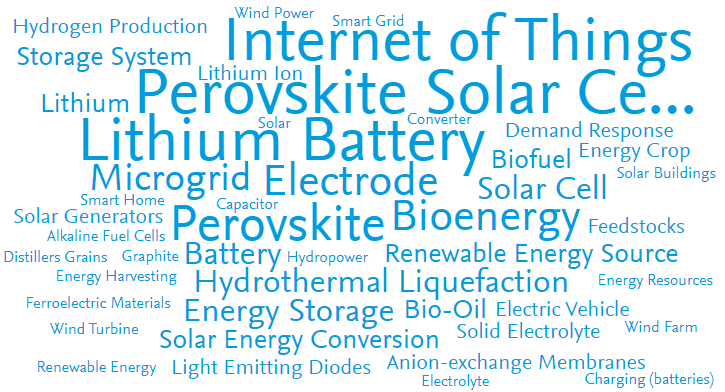
Source: SciVal.com | This word cloud was created using publications from Penn State researchers
Research & Publications

Researchers

Publications

Grants

Research Units

Classes
Related News
Making rechargeable batteries more sustainable with fully recyclable components
Rechargeable solid-state lithium batteries are an emerging technology that could someday power cell phones and laptops for days with a single charge. Offering significantly enhanced energy density, they are a safer alternative to the flammable [...]
Penn State, Shell announce collaboration focused on energy and sustainability
Penn State and Shell USA Inc. have announced the launch of a collaboration that will support efforts across the University’s mission of research, education and community impact. An initial commitment from Shell of more than [...]
Penn College’s Clean Energy Center to open Pittsburgh facility in early 2025
Pennsylvania College of Technology’s Clean Energy Center has announced a new strategic partnership with Pittsburgh Gateways Corp. to bring nationally recognized clean energy workforce solutions to Pittsburgh. The Clean Energy Center selected Pittsburgh Gateways to [...]
Berks student team developing EV charging stations receives national recognition
Penn State Berks student startup team Streamline Charging LLC has received national and University-wide recognition for its flexible and affordable electric vehicle (EV) charging solution that transforms the charging experience for apartment dwellers and service [...]
Scientists develop new method to create stable, efficient next-gen solar cells
Next-generation solar materials are cheaper and more sustainable to produce than traditional silicon solar cells, but hurdles remain in making the devices durable enough to withstand real-world conditions. A new technique developed by a team [...]
Penn State hosts SPARK 2050 energy summit to ignite energy transformation
To answer former Pennsylvania Gov. Tom Wolf’s call for an 80% cut to carbon emissions in the commonwealth by 2050, more than 100 stakeholders from across academia, government, industry and nonprofit sectors convened at Penn State [...]
Yes, there is a Penn State OPP Policy requiring new buildings to be LEED certified.
Penn State has robust plans to upgrade existing buildings to be more energy efficient. Please refer to this article and this OPP LEED Policy for more information.
Yes, Penn State has a process to reduce carbon emissions. In 2021, Penn State’s Carbon Reduction Task Force created a plan to reduce Penn State’s emissions by 100% by 2035. The actions are outlined in the plan provided. Penn State Sustainability also tracks carbon emissions on Penn State Sustainability’s Carbon Emissions dashboard. Other current efforts include the Scope 3 team and the Carbon Action Teams that are making conscious efforts to reduce emissions at the University.
Yes, Penn State has multiple plans to reduce energy consumption. Policy AD64, the Energy Conservation Policy (created 2009, reviewed 2015), was enacted to reduce the University’s energy consumption to support greenhouse gas reduction goals and to reduce expenditures on energy. Some concrete examples include the Energy Savings Program, Continuous Commissioning, and Energy Conservation Measures. To learn more about these plans, please refer to Penn State Sustainability’s Energy page.
Yes, Penn State Sustainability has an EUI (Energy Use Intensity) Dashboard to highlight which buildings consume the most energy, which highlights opportunities to reduce energy usage. Additionally, Penn State has energy conservation measures (ECMs) to reduce the amount of energy use in buildings by introducing more efficient technologies. There are also plans to take inefficient buildings offline.
In Penn State’s 2023 Investment Policy Statement, Penn State has stated that “The Investment Policy Return Objective states that the Long Term Investment Pool will be invested to achieve maximum return with an acceptable degree of risk. Within the context of its fiduciary responsibilities, Penn State Investment Council may continue to take social and environmental considerations into account in the administration of the University’s investments”
Yes, Penn State Extension provides resources to learn more about energy efficiency incentive programs for the local community.
No, the University does not have a public pledge towards 100% renewable energy, but is actively promoting the uptake and transition to renewable energy. For instance, Penn State hosted the SPARK 2023 summit, which convened more than 100 stakeholders from academia, research, and industry to build the vision for a clean energy future in PA. Additionally, PSU hosts yearly Climate Solutions Consortiums, which brings together local experts, partners, and community members to address the complete energy transition by 2050. Additionally, Penn State has invested in multiple renewable energy projects such as solar panels and hydroelectric power. The University has also signed a 25 year Solar Power Purchasing Agreement with Franklin County.
Yes, Penn State’s Energy Institute in the College of Earth Mineral Science provides technical services to local, national, and global industry partners aimed at improving energy efficiency and clean energy. Some of the technical services include: Qualitative imaging, mineral sample banks, and reference materials. Additionally, PennTAP, a Penn State and PA Commonwealth collaboration, provides energy assessments to local industries to identify areas of improvement for clean energy. Penn State EMS also conducts research on renewable energy to provide services to industry.
Yes, Penn State’s Center for Energy Law and Policy (CELP) does research on the successful implementation of energy policy, and collaborates with government stakeholders with the findings of its research to inform energy policy. Also Penn State has the LCAP Program, which allows students to collaborate with local governments to support sustainable policy development at the local level, which can include clean energy and energy efficient technology.
Yes, Penn State has a facility called “Invent Penn State,” which provides mentoring, funding, and networking opportunities to students with a potential business idea, which involves low-carbon technology. Through this service, students with low-carbon energy ideas can develop them through the support of the university.
About this SDG
Targets & Indicators
Target 7.1: By 2030, ensure universal access to affordable, reliable and modern energy services
- Indicator 7.1.1: Proportion of population with access to electricity
- Indicator 7.1.2: Proportion of population with primary reliance on clean fuels and technology
Target 7.2: By 2030, increase substantially the share of renewable energy in the global energy mix
- Indicator 7.2.1: Renewable energy share in the total final energy consumption
Target 7.3: By 2030, double the global rate of improvement in energy efficiency
- Indicator 7.3.1: Energy intensity measured in terms of primary energy and GDP
Target 7.a: By 2030, enhance international cooperation to facilitate access to clean energy research and technology, including renewable energy, energy efficiency and advanced and cleaner fossil-fuel technology, and promote investment in energy infrastructure and clean energy technology
- Indicator 7.a.1: International financial flows to developing countries in support of clean energy research and development and renewable energy production, including in hybrid systems
Target 7.b: By 2030, expand infrastructure and upgrade technology for supplying modern and sustainable energy services for all in developing countries, in particular least developed countries, small island developing States and landlocked developing countries, in accordance with their respective programs of support
- Indicator 7.b.1: Installed renewable energy-generating capacity in developing countries (in watts per capita)