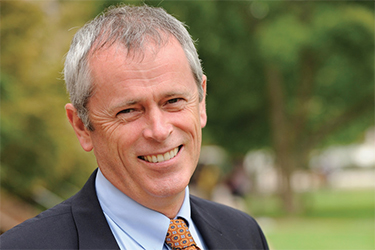
Grant Rowe, Sustainability Coordinator for the Borough of Doylestown, PA and Penn State alum
Grant Rowe uses his experience curating sustainable programs to inform community engagement and climate policy as the first sustainability coordinator for the Borough of Doylestown, Pennsylvania. Rowe is helping this small Bucks County municipality build its climate action plan from the ground up. After coordinating sustainability programming at Penn State, and completing the Local Climate Action Program (LCAP) as a part of Penn State’s Renewable Energy and Sustainability Systems master’s program, Rowe now leads greenhouse gas inventory, grant and contract strategy, and resident engagement for the Borough.
(This conversation has been edited for length and clarity.)
Can you tell us about your path to sustainability, from undergraduate work, to master’s and now your profession in sustainability?
I graduated in 2023 from Susquehanna University, a small liberal arts college, where I studied environmental studies and political science. After graduating, I joined the Penn State Sustainability office as their sustainability programming coordinator, starting in October 2023.
In that role, I put together events for students and the broader community. Events included online film series screenings, where we’d screen a documentary and then bring on panelists who specialize in the topic. We hosted several speaker series that brought in specialists who may be of topical interest to students. We had a huge range of academics, practitioners, and artists. What I loved most was bringing different communities together around a shared conversation.
The sustainability programming coordinator role at Penn State Sustainability was designed as a springboard: a way for recent grads with passion but who didn’t have five to seven years of experience on their portfolio, who wanted to use the position to build towards more meaningful initiatives. I got lucky with two people who ran the Local Climate Action Program (LCAP), Peter Buck and Brandi Robinson. Although LCAP was not a requirement of the Renewable Energy and Sustainability Systems (RESS) master’s program, it was a great supplement. Our offices happened to be next to each other, and that connection changed the direction of my life.
About two years in, while I was finishing my master’s degree, an opportunity opened up to become the first sustainability coordinator for a local municipality. Almost all of that work would mean engaging directly with residents, whether through educational workshops or policy work, which was exactly the kind of community-facing work I’d loved at Penn State. I couldn’t pass it up and I started in Doylestown in June of 2025.
What did the Local Climate Action Program teach you, and how did it prepare you for this role?
The LCAP is a two-semester course. In the first semester, you’re paired with a local government and you measure all of their emissions including commercial and residential energy, potable water, wastewater, solid waste, and transportation. All of those emissions are compiled into a full greenhouse gas inventory. In the second semester, you work with that same community partner to identify actions that would reduce the emissions you just measured.
That process is what convinced me this work mattered on two levels. First, we genuinely need people who know how to measure emissions accurately, so that we can tell whether we’re making progress. Second, working with local governments means working with people whose decisions ripple out and affect an entire community. That thread ran through the rest of the LCAP and my master’s program, which ended in a thesis that included another greenhouse gas inventory, for a local government near where I grew up. I also did contract work on a greenhouse gas inventory for the city of Harrisburg. All of these experiences kept pulling me back to local government.
The Penn State Sustainability programming coordinator role deserves credit for shaping how I engage at the community level. Since taking on my full-time sustainability coordinator role in Doylestown, other municipalities reach out to me directly, asking what a full time sustainability coordinator role looks like. I see it as a chain. Neighboring Solebury Township created the position due to community and township leadership support and ambition for further sustainable actions. Solebury Township has adopted an ambitious energy transition plan that aims to reach 100% renewable electricity by 2035. They needed a full-time person to accomplish such a large goal, then Doylestown followed suit with similarly ambitious targets. My advice to any town considering creating this position is to hire the person who has the passion and can learn the local government specifics quickly, rather than waiting for 10 years of experience.
Can you walk us through your current role in Doylestown?
I’m the sustainability coordinator for the Borough of Doylestown, a very small borough, roughly two square miles. I work directly with community members and residents on the Borough’s own climate action plan and greenhouse gas inventory. That includes exploring grant and funding opportunities, working on projects like electric vehicle procurement, and serving as staff liaison to our Environmental Advisory Council, a group of volunteer community members who meet monthly to raise ideas and push initiatives forward. That council, frankly, is part of why this position exists at all. There was demand and advocacy from residents before there was a job.
What do you think makes Pennsylvania unique for this kind of work?
A few things converge here. Pennsylvania has a unique physical landscape with major cities like Philadelphia alongside rural central Pennsylvania with farmland. These landscapes, ethics, and lifestyles are situated side by side. Pennsylvania is also one of the few states with environmental protections written into its constitution, so there is a legal dimension to sustainability work here that doesn’t exist everywhere. And politically, it’s a swing state so Republicans, Democrats, and everyone in between, are all fighting for the same ground.
I think that combination is actually an advantage. Pennsylvania also has a fragmented local government structure with townships, boroughs, and 67 counties each with their own municipalities. If you can get environmental action done across that kind of fragmented landscape, the principles can be translated anywhere.
If you could change one thing, individually and systemically, what would have the biggest climate impact?
On an individual level, I think the first step is making sure someone is actually able to sustain themselves (food, shelter, rent) before we ask anything more of them. Early in my own environmental work, my instinct was to ask why everyone wasn’t doing what I was doing. But that ignores privilege and circumstance. If you come at people demanding change and blaming them, they shut down. I think the climate movement is sometimes too aggressive in people’s faces, when the more effective approach is finding where our interests already align. Someone might want a walking path so their kids don’t have to cross a highway, for instance, and that is simultaneously creating green space and carbon sequestration, even if climate wasn’t their entry point.
On a systemic level, if I had to pick one lever, it would be money in politics. If we could remove outside funding and lobbying money from major corporations, from fossil fuel companies, from politics, we’d actually be able to hold politicians accountable and remove the incentives keeping outdated industries propped up.
What’s your response to people who say sustainability work isn’t profitable?
I get this question constantly, and I think it’s the right question to ask, just not the complete one. Yes, I’ve pursued and secured grant funding for the Borough, and that return-on-investment conversation matters. We’re spending taxpayer dollars, and I want to spend them effectively. When someone looks at electric vehicles for example, the case is often straightforward: at 15,000 miles a year, the higher upfront cost breaks even; and it breaks even considerably faster on emissions.
But if you only ask what a sustainability officer has directly saved or brought in, you’re missing the other half of the ledger: the cost of doing nothing. We’re seeing more billion-dollar climate disasters every year. Locally, that looks like homeowners paying thousands of dollars to remove storm-damaged trees or repair flood damage from rainfall patterns that didn’t used to exist — not less total rainfall, but rainfall that now comes in three or four catastrophic bursts instead of being spread through the year. It also shows up in public health: asthma and cardiovascular illness rates climb with poor air quality.
We routinely calculate how expensive it is to put solar on a roof or buy an electric vehicle, but we almost never calculate the value of the emissions we’re not putting into the air by doing so. I don’t buy gas anymore, and yes, I pay an EV road tax to make up for the gas tax I’m no longer paying, which I think is fair. But we should be just as rigorous about pricing in the benefit of the transition as we are about pricing in its up-front cost. Until we do that, the accounting will always look tilted against the more sustainable choice, even when it isn’t.
What advice would you give to someone trying to break into this field?
There are real barriers to entry. A lot of sustainability postings ask for five or 10 years of experience, which is daunting for anyone just starting out. My honest advice is: It will come, so don’t give up. In the meantime, there’s real value in volunteering. Community gardens always need help, local governments often have volunteer advisory councils like the one I staff, and that kind of unpaid experience is frequently what leads directly to a paid role. My own position likely exists because residents on our Environmental Advisory Council were already advocating for it before the job was ever posted.
Whenever I need a piece of art or literature to keep me motivated, I like to reference “The Ministry for the Future” by Kim Stanley Robinson. It’s a long book, but it’s grounded largely in the present, in the institutions we actually operate in, and it follows people directly harmed by climate change alongside government employees and activists trying to figure out the balance between policy change and direct demand. It’s one of the more passionate books I’ve read on what it actually takes to move on this.